You Know Something Needs to Change. They Are Not Ready.
You have brought it up before. Maybe more than once.
You suggested therapy. You mentioned that you have been feeling disconnected, that the same argument keeps happening, that something between you has shifted and you are not sure how to fix it on your own. And your partner said no. Or not now. Or maybe later. Or said that talking to a stranger about your relationship is not something they are interested in doing.
So here you are. Still in the relationship, still caring about it, still wanting something to get better. Wondering whether there is anything you can do when only one of you is willing to try.
The answer is yes. And it is not the consolation prize you might think it is.
I am Sabita Nandy, a Licensed Marriage and Family Therapist practicing in Chicago. I see clients at my Loop office at 125 S Wacker Drive and my Michigan Avenue office at 401 N Michigan Ave. A significant part of my individual therapy practice involves working with people who are navigating relationship challenges alone in the therapy room, while their partners stay home.
This post is for anyone in that position.
The Data on Partner Refusal
You are not in an unusual situation. Research on barriers to couples therapy consistently finds that roughly a third of people who want couples counseling do not go because their partner refuses. If you have experienced this, you already know the specific isolation it creates: you want help, you recognize a problem, but you cannot access the support you want because it requires both of you to agree.
At the same time, data from the Journal of Marital and Family Therapy shows that over 70 percent of couples who do attend therapy together report meaningful improvement in their relationship. Which is real and hopeful. But it also points to something worth sitting with: couples therapy requires both people to show up, be honest, and be open to change.
If one person is not there, the format does not work. But the relationship can still change. Because relationships are systems, and when one part of a system shifts, the whole system shifts.
You cannot force your partner into therapy. But you can change your part of the dynamic. And that changes more than most people expect.
Why Partners Refuse Couples Counseling
Before assuming your partner is being stubborn or avoidant, it is worth understanding what is usually underneath a refusal.
Fear of Judgment
Many people worry that a therapist will take sides, or that they will be identified as the problem. This fear is especially common in people who grew up in families where emotions were not handled safely, or where authority figures were not trustworthy. The therapy room, to someone with this history, can feel like a trap.
Shame About the State of the Relationship
Seeking couples therapy means admitting that something is wrong. For some people, particularly those with strong self-sufficiency values, this feels like a public failure. Statistics on couples therapy barriers show that nearly 60 percent of couples who live together believe therapy is only for very serious problems, which means many resist it until things are already in crisis.
A Previous Bad Experience
If your partner has tried therapy before and found it unhelpful, dismissive, or actively harmful, their reluctance makes complete sense. Not all therapeutic experiences are good ones, and past experiences shape how people approach the idea of going back.
Belief That It Will Not Help
Some people genuinely do not believe therapy works. This is sometimes a defense, but it is also sometimes a sincere position based on their experience and worldview. Arguing them out of it rarely succeeds.
Feeling That the Problem Is the Other Person
If your partner believes that the relationship would be fine if you would just change, they have no motivation to attend. Why would they sit in a room being assessed for problems they do not think they have?
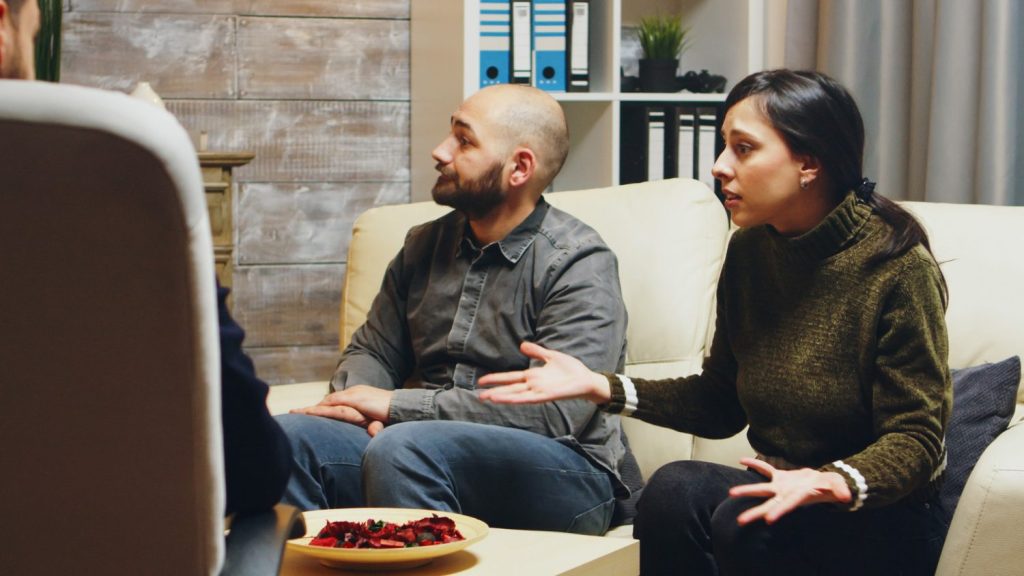
What Individual Therapy Can Actually Do for Your Relationship
Relationship therapy for one, when one partner is navigating relationship challenges, is not a substitute for couples therapy. It is something different. In some ways, it is more foundational.
It Helps You See Your Own Patterns Clearly
Every relationship problem has two inputs. When you are deep inside a conflict, it is almost impossible to see your own contribution clearly. Individual therapy creates the distance needed to examine what you bring to the dynamic: the fears driving your behavior, the inherited beliefs shaping your expectations, the communication patterns you default to when you are stressed or scared.
This is not about assigning blame to yourself. It is about gaining clarity about what is actually happening and what is within your control to change.
It Shifts the System
Relationships are systems. When you change your behavior, your partner has to respond differently. This is not manipulation. It is physics.
If you typically pursue and they typically withdraw, and you learn through therapy to stop pursuing in the ways that trigger withdrawal, the dynamic cannot continue in the same form. Your partner will either move toward you, or the nature of the pattern becomes visible in a new way. Either outcome gives you information you did not have before.
This mechanism is recognized in the clinical literature. Research on individual therapy for relationship issues confirms that going to individual therapy can change the dynamic of a relationship even when only one partner attends.
It Helps You Manage Your Own Distress
Being in a struggling relationship while your partner is not willing to work on it is genuinely painful. Individual therapy gives you a place to process that pain without taking it out on your partner, without going silent and resentful, and without the kind of emotional flooding that makes difficult conversations impossible.
Regulated people have better relationships. When you are less overwhelmed, you are more able to stay present during conflict rather than shutting down or escalating.
It Helps You Get Clear on What You Actually Want
Sometimes the most important work individual therapy does is help you understand what you truly want from this relationship, what your non-negotiables are, and what you are and are not willing to continue living with.
This is not necessarily a path toward leaving. Often it is a path toward a clearer, more honest version of staying. But it requires knowing yourself, and that takes a kind of reflection that most people only do with support.
What I Work on With Clients in This Situation
When someone comes to me navigating relationship challenges alone in therapy, our work tends to move through a few consistent areas.
Understanding the Pattern
Every struggling relationship has at least one central pattern: a cycle of interaction that repeats under stress. Pursue and withdraw. Attack and defend. Demand and distance. Understanding which pattern you are in, and what function it serves for both of you, is the starting point for anything changing.
Tracing the Pattern Back
Where did you learn your half of this dynamic? Almost always, the patterns playing out in adult relationships have roots in earlier relationships, often in the family of origin. The hypervigilance that looks like nagging. The emotional unavailability that looks like stonewalling. The need for control that looks like jealousy. These are not personality flaws. They are adaptive strategies that made sense once and are now causing problems in a context where they no longer fit.
This is the core of the generational healing work I do. Understanding the inherited roots of current patterns is not about dwelling in the past. It is about seeing clearly enough to choose differently.
Communication and Repair
We work on how you bring things up, how you respond when things escalate, and how you attempt repair after rupture. Small changes in communication patterns can have significant effects on relationship quality, even when those changes are only coming from one person initially.
Managing the Uncertainty
When you are doing your own work and your partner is not doing theirs, there is an inherent uncertainty about where the relationship is going. That uncertainty needs to be held somewhere. Therapy is the container for it. Without it, the anxiety about the future tends to spill into every interaction you have with your partner, making genuine connection even harder.

When Your Partner Eventually Comes Around
It happens more often than you might expect. Research from Psych Central notes that individual therapy can shift the relationship dynamic in ways that open the door to couples work later.
When one partner starts therapy and genuinely changes, the other partner often notices. The escalation that used to happen does not happen the same way. The shutdown that always followed conflict starts to feel less necessary. The person who did not want therapy starts asking questions about what is happening in those sessions.
Not always. But often enough that the individual work is worth doing regardless of where the relationship ultimately goes.
If and when your partner does become open to couples therapy, the individual work you have already done makes couples therapy more effective. You come in with self-awareness and a clearer picture of the pattern. The work can go deeper, faster.
What Staying in Individual Therapy Looks Like Practically
I see clients at my Loop office on Monday through Thursday, with sessions available from 10 AM to 8 PM, including lunch-hour appointments for Chicago professionals. My Michigan Avenue office offers Friday and Saturday sessions. Online therapy is available throughout Illinois for anyone whose schedule or location makes in-person sessions difficult.
I accept Blue Cross Blue Shield PPO, Aetna PPO, and United Healthcare PPO. Self-pay is $200 per 60-minute session.
The first step is scheduling your first appointment. We talk briefly about what you are navigating, and you get a sense of how I work. No paperwork before that, no commitment.
A Few Questions Worth Sitting With
If you are reading this and trying to decide whether to reach out, here are some questions worth honest reflection:
- What would change in your relationship if you showed up differently? What would different even look like?
- What patterns do you notice in yourself under relationship stress? Where did those patterns come from?
- What is the story you are telling about why your partner will not go to therapy? How certain are you that story is complete?
- What would you need to feel clear about what you want from this relationship and from your life?
- If the relationship does not change, what does that mean for you?
These are not easy questions. They are not meant to be. But they are the right questions. And therapy is a place to hold them honestly.
Ready to talk? Call 312-607-4277 or email sabitanandy@sabitanandy.com to schedule your first appointment.
Learn more about individual therapy at my Chicago practice or couples therapy options for when you are both ready.